The 2026 World Cup, kicking off 11 June, arrives buried under problems that have little to do with football.
Unprecedented complexity. This is the first World Cup FIFA must pull together itself, across three nations and 16 host cities with layers of stakeholders and bureaucracy – a structure critics say was overstretched from the start.
Ticketing scandal. FIFA deployed dynamic pricing for the first time , sending the dearest final seats from $6,730 to $10,990 by April. Average costs rose 35% across 95 of 104 matches. Even President Trump said he wouldn’t pay those prices. “I would certainly like to be there, but I wouldn’t pay it either, to be honest with you,” Trump told the New York Post in a recent interview. The New York and New Jersey attorneys general have opened an investigation into exorbitant costs, fans misled over seat locations, and staggered sales used to inflate demand , while FSE and Euroconsumers filed a complaint alleging FIFA abused its monopoly to impose excessive prices.
Visa and entry chaos. South Africa delayed departure over unissued visas, Iran and Haiti faced outright travel bans, and a Somali referee was denied US entry. Lawmakers warn of revocations, detentions at ports of entry, and obstacles that could suppress global fan attendance.

Political interference. In perhaps the most damaging episode, a Trump ally asked FIFA to have Italy replace Iran – a side that hadn’t even qualified – reportedly to smooth relations with Meloni. It caused global headlines and was widely branded embarrassing. FIFA held firm that Iran would play, but Trump’s travel ban still barred ordinary Iranian fans from entering the US , exposing how sharply geopolitics now cuts across the tournament.

Heat and player welfare. A climate report found 10 of the 16 venues face a “very high risk” of extreme heat stress , prompting FIFPRO to urge longer breaks and cooler kickoff times.
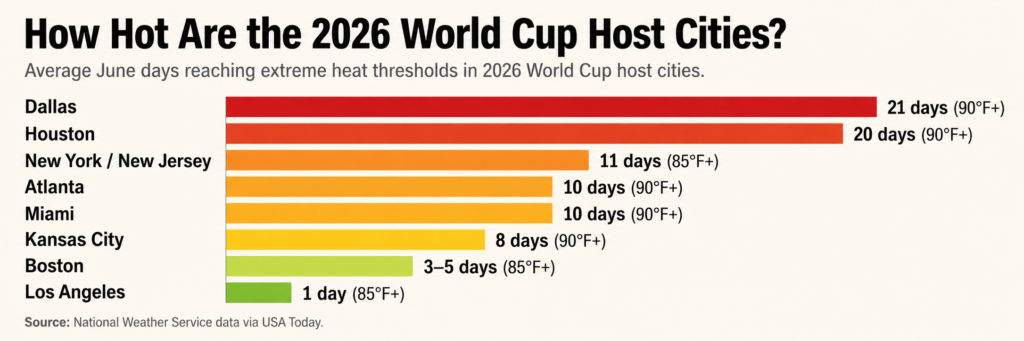
Punishing logistics. Spread across four time zones with 13 different kickoff times , teams face brutal travel – Spain alone travels 1,469 miles before facing Uruguay.
Environmental cost. Emissions are projected to be almost double the average of the last four tournaments, roughly equal to 6.5 million cars driven for a year.