
For all the talk of a festival of football across three nations, the 2026 World Cup is, financially, an advertising platform that happens to stage matches. FIFA is targeting roughly $11 billion across its 2023–26 commercial cycle, with the tournament itself generating approximately $8.9 billion – a sum that dwarfs every previous edition and reframes the competition as the most commercially powerful event in sporting history.
The sponsorship pyramid
The architecture is deliberate. FIFA does not sell a single package; it sells tiered access. At the apex sit the FIFA Partners – Adidas, Coca-Cola, Hyundai-Kia, Visa, Qatar Airways, Aramco and Lenovo – who hold rights across all FIFA competitions, with top-tier deals estimated well above $500 million over a partnership period. Beneath them, the tournament-specific Sponsors – among them Budweiser owner AB InBev, Bank of America, Frito-Lay, Hisense, McDon’s, Mengniu, Unilever and Verizon – pay an estimated $65 million to $95 million for 2026-only rights. A third, novel layer lets each of the 16 host cities sign up to ten local sponsors, monetising even the fan festivals.
The result is a record. FIFA has confirmed that all global sponsorship packages have sold, generating the highest sponsorship revenue ever recorded for a standalone sporting event – projected at $2.5 billion to $3 billion, a figure Ampere Analysis puts at a 37 per cent increase on 2022.
The broadcast windfall
Media rights are larger still. FIFA expects close to $3.92 billion from broadcasting deals, roughly 36 per cent of total cycle revenue. The United States is the engine: Fox’s English-language rights are valued at about $480 million and Telemundo’s Spanish-language deal at around $465 million, with North American rights exceeding $1 billion in total. The home-market premium is stark – US rights revenue has climbed sharply against the Qatar cycle, when American interest was suppressed by unfavourable time zones and a national side that failed to qualify.
Crucially, rights are only the floor. The two US networks together project $850 million in advertising revenue, up from $384.3 million in 2018 – approaching Super Bowl economics, albeit spread across 104 matches rather than a single game. For context, a 30-second Super Bowl spot now commands around $8 million.
The hydration break: what is fact
Here the commercial and the sporting collide. For the first time, FIFA has mandated two scheduled hydration breaks in every match – one midway through each half – regardless of weather, kick-off time, stadium roof or cooling system. This is a structural departure: previous tournaments paused only in extreme heat, on a temperature trigger. The 2026 breaks are automatic and universal, effectively turning the game into four quarters, which has upset traditionalists.
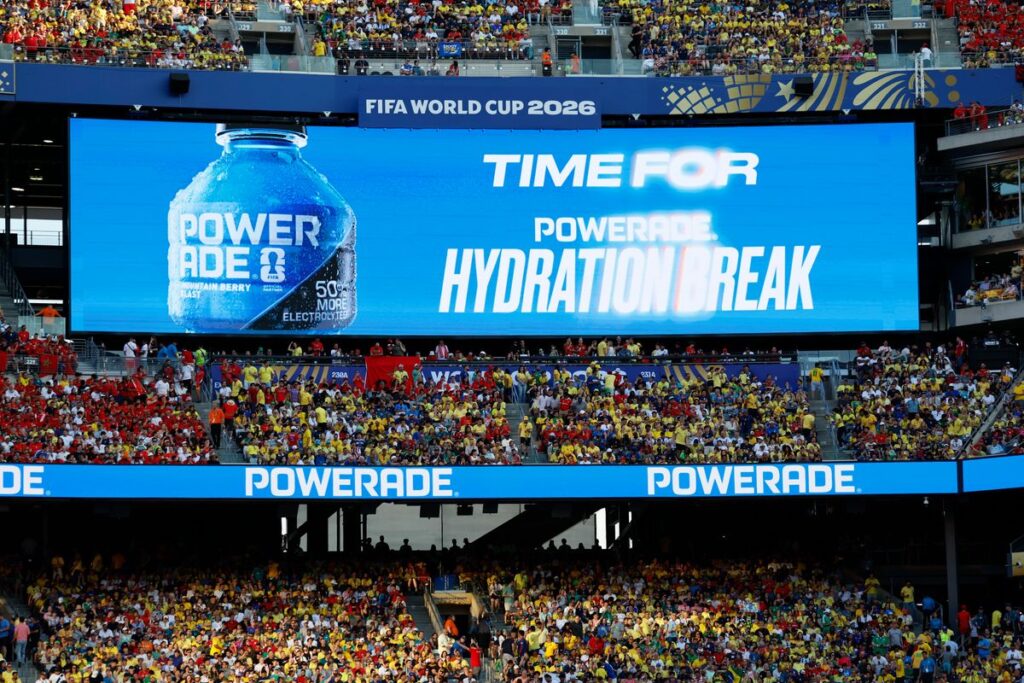
Three months after announcing them, FIFA confirmed the second half of the equation. Broadcasters were given the green light to sell advertising during the breaks, with a 20-second buffer before commercials begin and a requirement to return at least 30 seconds before play resumes – yielding as many as 832 commercial slots across the tournament. Fox has moved to monetise the inventory across broadcast and its streaming service. Telemundo, notably, has declined to, staying on the match feed to preserve an authentic viewing experience. The fact that a major rights-holder can simply refuse the slots tells you they are inventory first and necessity second.